
Author: Bryan Lin
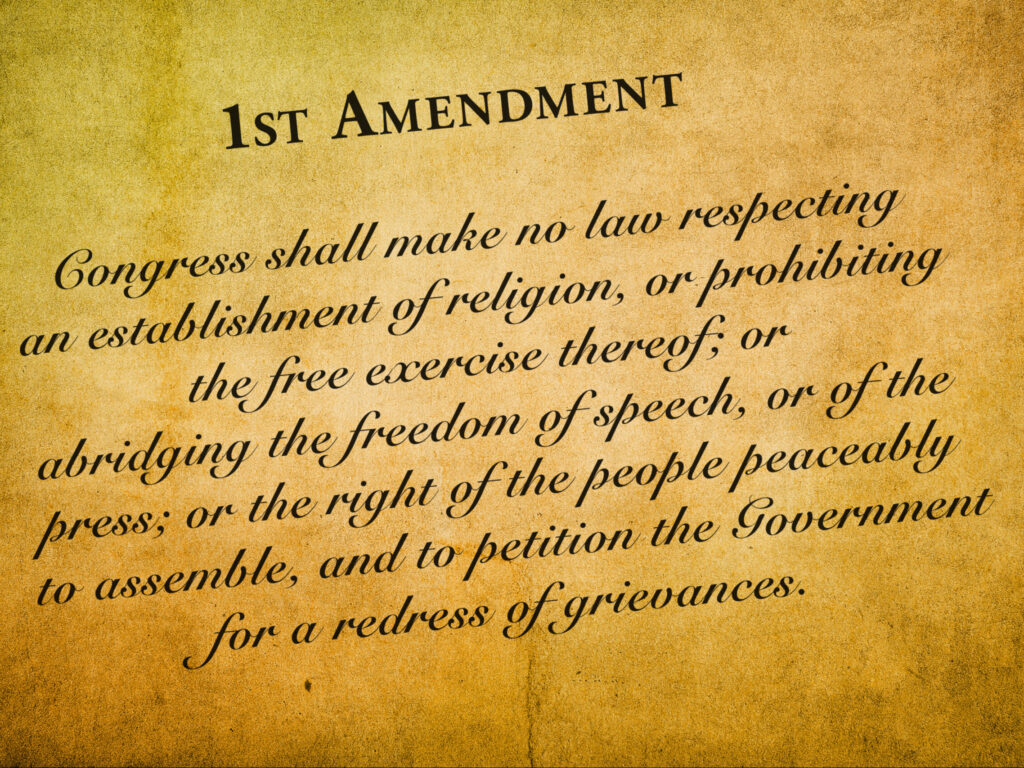
“Congress shall make no law respecting an establishment of religion, or prohibiting the free exercise thereof; or abridging the freedom of speech, or of the press; or the right of the people peaceably to assemble, and to petition the Government for a redress of grievances.” These forty-five words, ratified in 1791 as the First Amendment to the United States Constitution, have likely generated more public controversy than perhaps any other provision in American law. While seemingly straightforward at first, its application to modern society and its standards are of much contention. In the Digital Age, freedom of speech protects amplified disinformation on social media platforms, helps perpetuate hate towards marginalized communities under the shield of ‘free speech’ and raises urgent concerns about safety on the internet. But how can we preserve the protections for free speech, to dissent and share unpopular opinions which have defined our democracy while still addressing the real-world consequences of unlimited free speech in the digital realm?
A huge concern that unlimited free speech raises in the digital age is the spread of misinformation on the internet. Because speech isn’t regulated, the posting and sharing of misinformation largely cannot be controlled. This can spread dangerous, harmful, and otherwise untrue ‘facts’ across the globe, faster than the founding fathers could have ever imagined. Research published by MIT found that falsehoods are 70 percent more likely to be retweeted on Twitter than the truth, and false news reached 1,500 people about six times faster than accurate information. Children are especially at risk when it comes to believing misinformation online. Many elementary schoolers think that information found on the internet is generally accurate and believe that a website is trustworthy simply based on how it looks, an article on Joan Ganz Cooney Center states. This means that young people easily believe and share false information, making the misinformation problem even worse across social media.
Beyond the general spread of misinformation that free speech on the internet facilitates, there is also the problem of hate speech. While there are still some very real consequences to hate speech on the internet (see cancel culture’s evolution), anyone can make a burner account, a blank account, and post hate speech on it while going mostly unpunished. Platforms such as X and Instagram are prime examples of places where hate speech is too normalized, with little censorship due to America’s policy of free speech. What may be a throwaway comment from a person on a burner account could cause harm that is anything but “throwaway” for the people who receive it. According to the Anti-Defamation League, more than half of Americans report experiencing some form of online harassment. The ADL also notes that marginalized groups (which includes racial, religious, and LGBTQ+ communities) face disproportionately higher rates of targeted harassment. The anonymity offered by burner accounts allows users to dodge accountability, which makes harmful rhetoric easier to spread and harder to punish/trace. This essentially perpetuates a narrative that you can say whatever you want and get away with it, even if your comment is directly hurting others.
But how can we address this problem while still keeping our liberties? While yes, free speech can cause a ton of misinformation and even hate, it is a foundation of what makes America so great. We should not focus our attention on extensive censorship that may take that away, but rather, a potential path forward could be platform accountability paired with transparent moderation standards. While the First Amendment restricts government regulation, private companies are legally permitted to moderate content. Research from organizations such as the Center for Countering Digital Hate has shown that when platforms consistently enforce their policies, the spread of harmful content decreases. Additionally, we can push forward digital literacy programs. The Stanford History Education Group found that many students struggle to evaluate online information and are often unable to distinguish credible sources from misinformation, which really highlights how we need digital literacy programs now more than ever.
Ultimately, preserving free speech in the Digital Age is a tricky problem to tackle. If we compromise our access to free speech, we could be lighting the way for a complete demolishing of the principle in the future, yet the real harm it poses shouldn’t go unnoticed. But, by promoting platform accountability, strengthening digital literacy, among other strategies, we can uphold our constitutional values while creating a safer, more responsible digital landscape for everyone.
Works Cited
Vosoughi, Soroush, et al. “The Spread of True and False News Online.” Science, vol. 359, no. 6380, 2018, pp. 1146–1151, news.mit.edu/2018/study-false-news-spreads-faster-true-news-twitter-0308. Accessed 13 Nov. 2025.
Getting Ready for School and Life: Creating an Effective Approach to Digital Literacy Learning for Young Children. Joan Ganz Cooney Center, 2018, joanganzcooneycenter.org/. Accessed 13 Nov. 2025.
Anti-Defamation League. Online Hate and Harassment: The American Experience 2024. 2024, www.adl.org/resources/reports/online-hate-and-harassment-the-american-experience. Accessed 13 Nov. 2025.
Times of Israel Staff. “ADL: 56% of Americans Report Online Harassment or Hate.” The Times of Israel, 30 Apr. 2024, www.timesofisrael.com/liveblog_entry/adl-56-of-americans-report-online-harassment-or-hate/. Accessed 13 Nov. 2025.
McMurtry, Danielle. “High School Students Unprepared to Spot Fake News, Stanford Researchers Find.” Stanford News, 19 Nov. 2019, news.stanford.edu/stories/2019/11/high-school-students-unequipped-spot-fake-news/. Accessed 13 Nov. 2025.
Center for Countering Digital Hate. Research. counterhate.com/research/. Accessed 13 Nov. 2025.